> ## Documentation Index
> Fetch the complete documentation index at: https://docs.turnkey.com/llms.txt
> Use this file to discover all available pages before exploring further.
# Payment Orchestration
> Build automated sweep, deposit, and treasury flows with policy-enforced access control and gas sponsorship.
export const SolutionCard = ({title, description, icon, href}) => {
return
;
};
export const FeatureCard = ({title, description, icon, logo, href}) => {
return
{logo ?  : }
: }
{title}
{description &&
{description}
}
;
};
Move funds programmatically across deposit, omnibus, and cold wallets with sub-100ms signing and policy-enforced access control at every transaction. For a basic signing walkthrough, start with the [Quickstart](/solutions/company-wallets/quickstart).
This guide covers the key implementation decisions for company wallet payment flows, then walks through a production example end-to-end: creating per-user deposit addresses, sweeping those deposits into an omnibus wallet with gas sponsorship, and gating treasury outflows with multi-party approval.
## Powered by Turnkey
Leading platforms use Turnkey to deliver onchain payment rails at scale:
* [**Squads**](https://www.turnkey.com/customers/how-squads-improves-ux-and-accounting-efficiency-with-turnkey) improved UX and accounting efficiency for multisig treasury management.
* [**Flutterwave**](https://flutterwave.com/us/blog/flutterwave-partners-with-turnkey-to-power-secure-stablecoin-wallets-for-customers) powers secure stablecoin wallets for customers across Africa.
## Key implementation decisions
| Decision | What to consider |
| :--------------------- | :------------------------------------------------------------------------------------------------------------------------------------------------- |
| Wallet architecture | Single HD wallet with many accounts (cost-efficient, shared seed) vs separate wallets per function (deposits, omnibus, cold) |
| Deposit addressing | Per-user deposit addresses via `createWalletAccounts` at no extra cost |
| Sweep strategy | Policy-enforced sweeps restricting deposit addresses to a single omnibus destination |
| Gas management | [Sponsored transactions](/features/transaction-management/broadcasting) (`sponsor: true`) eliminate the need to fund each deposit address for gas |
| Chain coverage | EVM and SVM require separate policies due to different transaction models |
| Hot wallet controls | Automated API key user with policies scoping exactly which transfers are allowed |
| Treasury controls | Multi-party approval via [consensus expressions](/features/policies/quickstart) (e.g., 2-of-N ops team) |
| Cold storage transfers | Policy-gated with parsed calldata for token transfers, or [upload the contract ABI](/features/policies/smart-contract-interfaces) for full parsing |
## Example: custodial payment processing
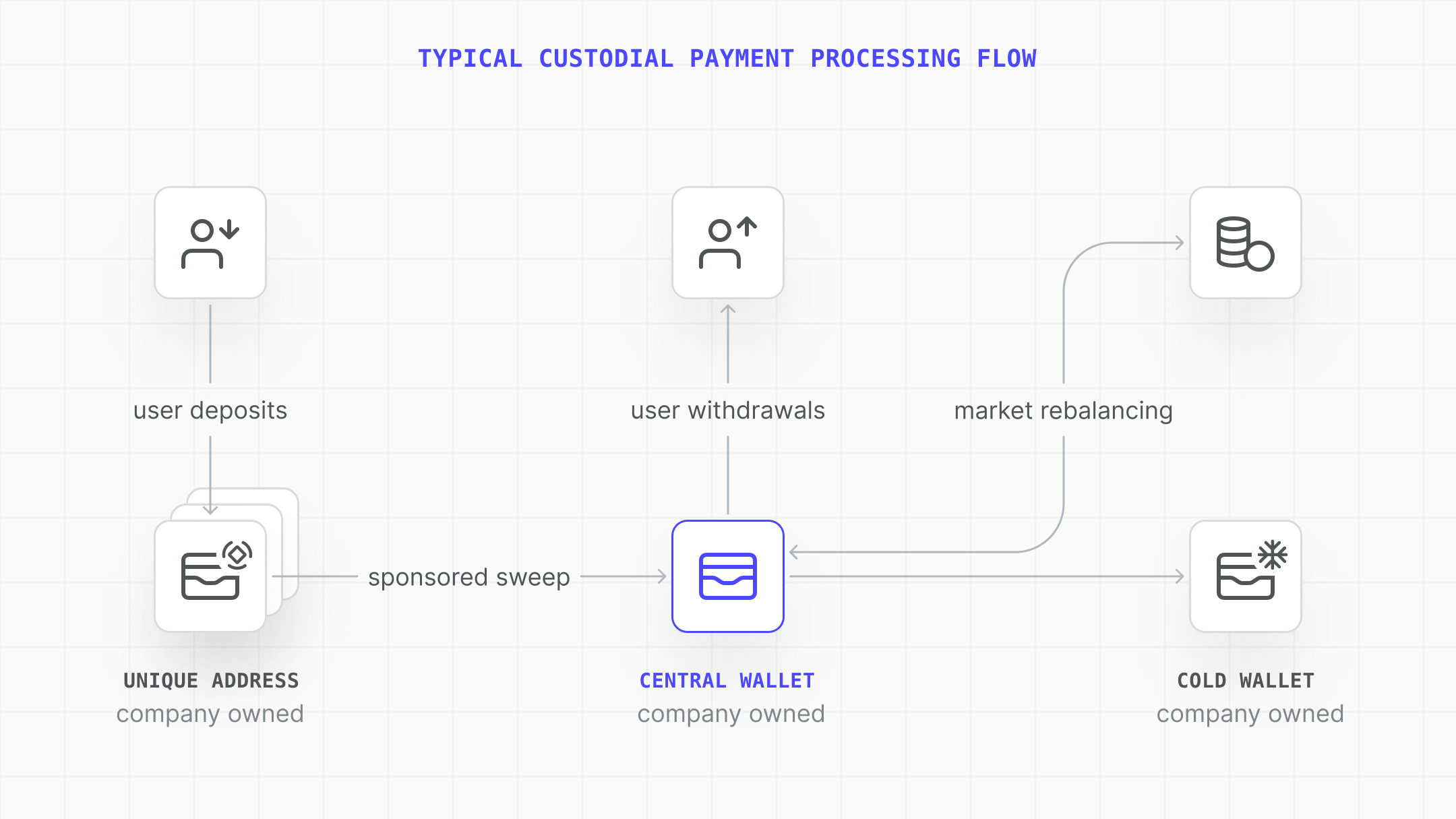
Exchanges and custodial payment processors are common examples requiring highly scalable, highly secure onchain systems.
 | Need | How Turnkey solves it |
| :-------------------------------------------------- | :--------------------------------------------------------------------------------------------------------------------------------------------- |
| All users have a unique deposit address | Wallet accounts are efficiently created and controlled within a Turnkey organization |
| Access to all wallets must be strictly permissioned | Policies enforce RBAC and least-privilege for all signing actions |
| Keys must never be exposed | Keys remain in the [secure enclave](/security/secure-enclaves); only signatures are returned |
| Must support automation and human review | Policies allow automation for routine tasks and require multi-party consensus for sensitive ones |
| Must move funds efficiently | [Transaction sponsorship](/features/transaction-management/broadcasting) eliminates the cost of funding thousands of deposit addresses for gas |
### Implementation steps
This guide assumes you've completed the [Quickstart](/solutions/company-wallets/quickstart) and have a Turnkey client initialized. If not, start there first.
Turnkey lets you create unlimited wallet accounts at no cost, each with a unique address belonging to the same underlying [wallet](/features/wallets). Create a deposits wallet with both EVM and SVM accounts:
```ts theme={"system"}
const { walletId } = await turnkeyClient.apiClient().createWallet({
walletName: "Deposits wallet",
accounts: [
{
curve: "CURVE_SECP256K1",
pathFormat: "PATH_FORMAT_BIP32",
path: "m/44'/60'/0'/0/0",
addressFormat: "ADDRESS_FORMAT_ETHEREUM",
},
{
curve: "CURVE_ED25519",
pathFormat: "PATH_FORMAT_BIP32",
path: "m/44'/501'/0'/0'",
addressFormat: "ADDRESS_FORMAT_SOLANA",
},
],
});
```
Then generate fresh deposit addresses on demand:
```ts theme={"system"}
async function createDepositAddresses(
turnkeyClient: Turnkey,
walletId: string
): Promise {
const addresses = await turnkeyClient.apiClient().createWalletAccounts({
walletId,
accounts: ["ADDRESS_FORMAT_ETHEREUM", "ADDRESS_FORMAT_SOLANA"],
});
return addresses.addresses;
}
```
This function can be triggered by end-user signup, a deposit request, or any internal flow.
Now that you have deposit addresses generating on demand, the next step is moving those funds into a central omnibus wallet. This is where the complexity typically starts: sweeping funds from thousands of addresses involves both security and cost considerations.
**Policy-enforced sweeps**
Create policies that restrict deposit wallets to only transfer to the omnibus address. EVM and SVM require separate policies due to their different transaction models:
```json theme={"system"}
{
"policyName": "(EVM) Deposit wallet sweep to omnibus",
"effect": "EFFECT_ALLOW",
"consensus": "approvers.any(user, user.id == '')",
"condition": "activity.action == 'SIGN' && wallet.id == '' && eth.tx.to == ''"
},
{
"policyName": "(SVM) Deposit wallet sweep to omnibus",
"effect": "EFFECT_ALLOW",
"consensus": "approvers.any(user, user.id == '')",
"condition": "activity.action == 'SIGN' && wallet.id == '' && solana.tx.transfers.count == 1 && solana.tx.transfers[0].to == ''"
}
```
Turnkey's Policy Engine is default-deny: you only specify the exact conditions to allow. Raw or obfuscated payloads are rejected unless explicitly permitted.
**Gas sponsorship**
Normally you'd need to fund every deposit address with gas before sweeping. Sponsored transactions bypass this entirely:
```ts theme={"system"}
const sendTransactionStatusId = await turnkeyClient.apiClient().ethSendTransaction({
transaction: {
from: depositAddress,
to: "OMNIBUS_ADDRESS",
caip2: "eip155:8453",
sponsor: true,
value: "0",
data: "0x",
nonce: "0",
},
});
```
See the [gas sponsorship guide](/features/transaction-management/broadcasting) for more details.
The omnibus wallet likely requires human-operator approval for outbound transfers and may need more sophisticated automations like asset rebalancing.
Create a user tag (e.g., `ops-team`) and apply it to your teammates, then set a policy requiring their approval for transfers to a cold wallet:
```json theme={"system"}
{
"policyName": "Require 2 ops-team for cold wallet deposits",
"effect": "EFFECT_ALLOW",
"consensus": "approvers.filter(user, user.tags.contains('')).count() > 1",
"condition": "activity.action == 'SIGN' && wallet.id == '' && (eth.tx.to == '' || (eth.tx.data[0..10] == '0xa9059cbb' && eth.tx.data[34..74] == ''))"
}
```
For token transfers, the policy above parses the ERC-20 `transfer` function signature. For production use, the recommended approach is to [upload the contract ABI](/features/policies/smart-contract-interfaces) for supported assets and act on fully parsed transactions.
## Next steps
| Need | How Turnkey solves it |
| :-------------------------------------------------- | :--------------------------------------------------------------------------------------------------------------------------------------------- |
| All users have a unique deposit address | Wallet accounts are efficiently created and controlled within a Turnkey organization |
| Access to all wallets must be strictly permissioned | Policies enforce RBAC and least-privilege for all signing actions |
| Keys must never be exposed | Keys remain in the [secure enclave](/security/secure-enclaves); only signatures are returned |
| Must support automation and human review | Policies allow automation for routine tasks and require multi-party consensus for sensitive ones |
| Must move funds efficiently | [Transaction sponsorship](/features/transaction-management/broadcasting) eliminates the cost of funding thousands of deposit addresses for gas |
### Implementation steps
This guide assumes you've completed the [Quickstart](/solutions/company-wallets/quickstart) and have a Turnkey client initialized. If not, start there first.
Turnkey lets you create unlimited wallet accounts at no cost, each with a unique address belonging to the same underlying [wallet](/features/wallets). Create a deposits wallet with both EVM and SVM accounts:
```ts theme={"system"}
const { walletId } = await turnkeyClient.apiClient().createWallet({
walletName: "Deposits wallet",
accounts: [
{
curve: "CURVE_SECP256K1",
pathFormat: "PATH_FORMAT_BIP32",
path: "m/44'/60'/0'/0/0",
addressFormat: "ADDRESS_FORMAT_ETHEREUM",
},
{
curve: "CURVE_ED25519",
pathFormat: "PATH_FORMAT_BIP32",
path: "m/44'/501'/0'/0'",
addressFormat: "ADDRESS_FORMAT_SOLANA",
},
],
});
```
Then generate fresh deposit addresses on demand:
```ts theme={"system"}
async function createDepositAddresses(
turnkeyClient: Turnkey,
walletId: string
): Promise {
const addresses = await turnkeyClient.apiClient().createWalletAccounts({
walletId,
accounts: ["ADDRESS_FORMAT_ETHEREUM", "ADDRESS_FORMAT_SOLANA"],
});
return addresses.addresses;
}
```
This function can be triggered by end-user signup, a deposit request, or any internal flow.
Now that you have deposit addresses generating on demand, the next step is moving those funds into a central omnibus wallet. This is where the complexity typically starts: sweeping funds from thousands of addresses involves both security and cost considerations.
**Policy-enforced sweeps**
Create policies that restrict deposit wallets to only transfer to the omnibus address. EVM and SVM require separate policies due to their different transaction models:
```json theme={"system"}
{
"policyName": "(EVM) Deposit wallet sweep to omnibus",
"effect": "EFFECT_ALLOW",
"consensus": "approvers.any(user, user.id == '')",
"condition": "activity.action == 'SIGN' && wallet.id == '' && eth.tx.to == ''"
},
{
"policyName": "(SVM) Deposit wallet sweep to omnibus",
"effect": "EFFECT_ALLOW",
"consensus": "approvers.any(user, user.id == '')",
"condition": "activity.action == 'SIGN' && wallet.id == '' && solana.tx.transfers.count == 1 && solana.tx.transfers[0].to == ''"
}
```
Turnkey's Policy Engine is default-deny: you only specify the exact conditions to allow. Raw or obfuscated payloads are rejected unless explicitly permitted.
**Gas sponsorship**
Normally you'd need to fund every deposit address with gas before sweeping. Sponsored transactions bypass this entirely:
```ts theme={"system"}
const sendTransactionStatusId = await turnkeyClient.apiClient().ethSendTransaction({
transaction: {
from: depositAddress,
to: "OMNIBUS_ADDRESS",
caip2: "eip155:8453",
sponsor: true,
value: "0",
data: "0x",
nonce: "0",
},
});
```
See the [gas sponsorship guide](/features/transaction-management/broadcasting) for more details.
The omnibus wallet likely requires human-operator approval for outbound transfers and may need more sophisticated automations like asset rebalancing.
Create a user tag (e.g., `ops-team`) and apply it to your teammates, then set a policy requiring their approval for transfers to a cold wallet:
```json theme={"system"}
{
"policyName": "Require 2 ops-team for cold wallet deposits",
"effect": "EFFECT_ALLOW",
"consensus": "approvers.filter(user, user.tags.contains('')).count() > 1",
"condition": "activity.action == 'SIGN' && wallet.id == '' && (eth.tx.to == '' || (eth.tx.data[0..10] == '0xa9059cbb' && eth.tx.data[34..74] == ''))"
}
```
For token transfers, the policy above parses the ERC-20 `transfer` function signature. For production use, the recommended approach is to [upload the contract ABI](/features/policies/smart-contract-interfaces) for supported assets and act on fully parsed transactions.
## Next steps

